
Cubic Footage Calculator
Calculate cubic footage for boxes, furniture, rooms and whole moves. Use the free calculator below for quick volumes, and get the planner kit for a room-by-room moving inventory that totals cubic feet and suggests truck and storage unit sizes.
- Instant download
- Editable Excel & Word
- Print-ready PDF
- 7-day refund
5 files · XLSX, PDF, DOCX
Moving & Storage Cubic Footage Planner
A room-by-room moving inventory workbook that totals cubic feet, item and box volume charts, a storage unit planner, checklists and box labels.
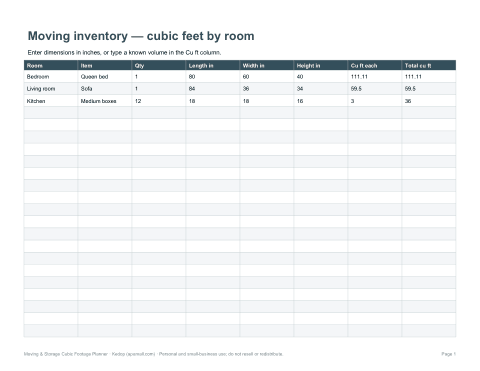
- Moving inventory workbook (XLSX, PDF)
- Item & box volume chart (PDF, XLSX)
- Storage unit planner (PDF, DOCX)
- + 2 more
$7.00 USD, one-time 5 files · about $1.40 each
- Instant download
- 7-day refund
- Secure checkout by Stripe
7-day money-back guarantee. Full refund within 7 days of purchase, even after you download.
Free sample: Moving Inventory Workbook (PDF, 59 KB)
Moving & Storage Cubic Footage Planner
A room-by-room moving inventory workbook that totals cubic feet, item and box volume charts, a storage unit planner, checklists and box labels.
- Moving inventory workbook (XLSX, PDF)
- Item & box volume chart (PDF, XLSX)
- Storage unit planner (PDF, DOCX)
- Packing & moving day checklists (PDF, DOCX)
- Printable box labels (PDF, DOCX)
Formats: XLSX, PDF, DOCX. Instant download after payment (link valid 72 hours, up to 5 downloads). AI-assisted: the templates were drafted with AI help and reviewed and laid out before publishing.
$7.00 USD, one-time 5 files · about $1.40 each
- Instant download
- 7-day refund
- Secure checkout by Stripe
7-day money-back guarantee. Full refund within 7 days of purchase, even after you download.
Free sample: Moving Inventory Workbook (PDF, 59 KB)
Full refund within 7 days — see the refund policy and license.
Free printables
Single sheets you can print right now, no sign-up. The full pack adds every sheet in one download plus the editable files.
 Printable Moving Inventory Workbook
 Printable Item and Box Volume Chart
 Storage Unit Planner Printable
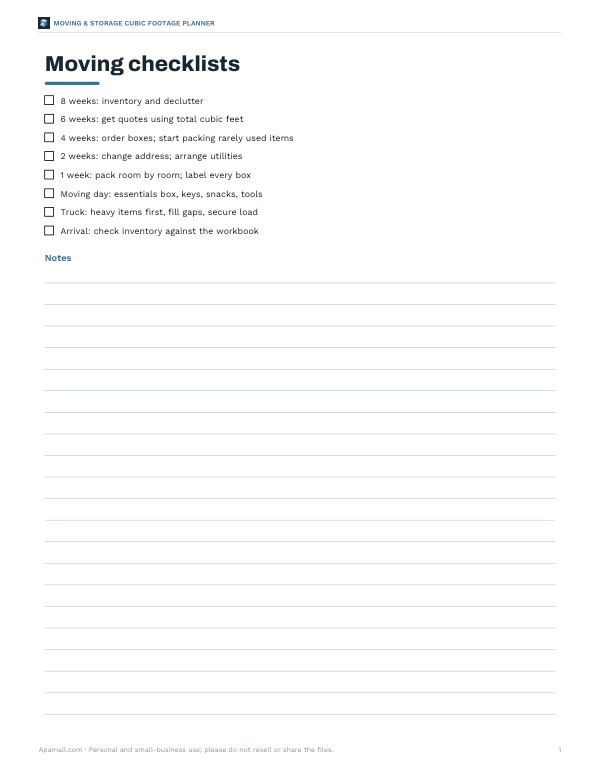 Printable Packing and Moving Checklists
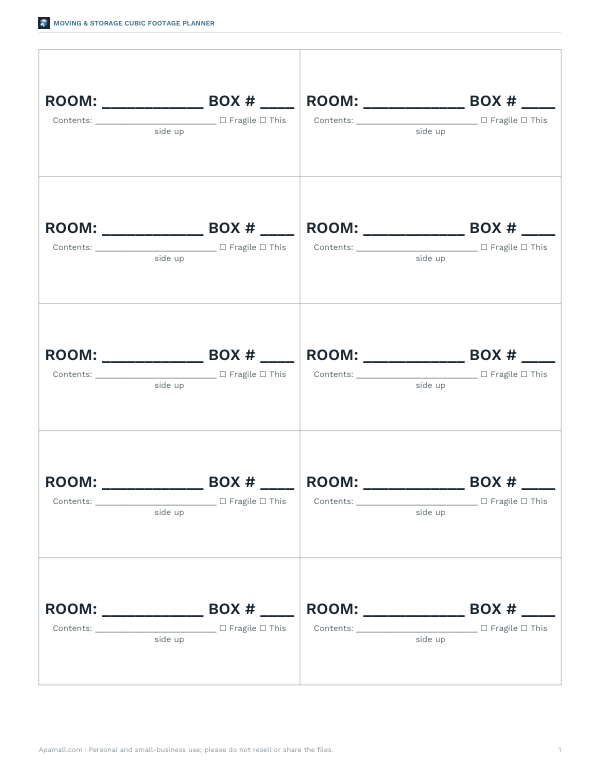 Printable Box Labels
Calculate cubic feet
Why cubic footage matters when moving or storing
Movers, truck rental companies and storage facilities all think in volume. Knowing roughly how many cubic feet your belongings occupy helps you choose the right truck, compare moving quotes that are priced by volume, estimate how many boxes you need and pick a storage unit that is big enough without paying for empty space. The calculator above handles individual items and boxes; the planner kit adds up a whole household room by room.
What is in the planner kit
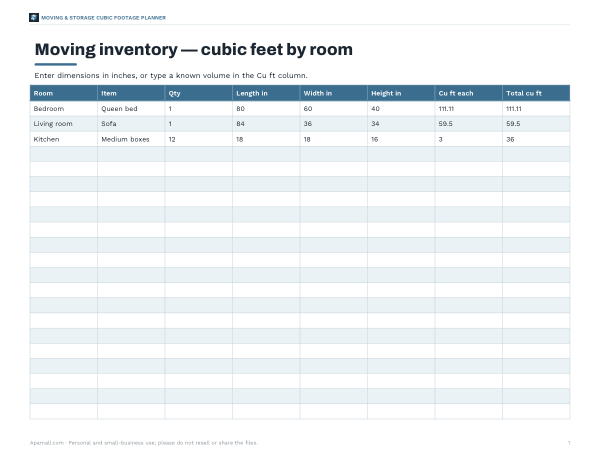
- Moving inventory workbook (Excel) — list items by room with dimensions or standard volumes; cubic feet, box counts and totals calculate automatically, with a suggested truck size.
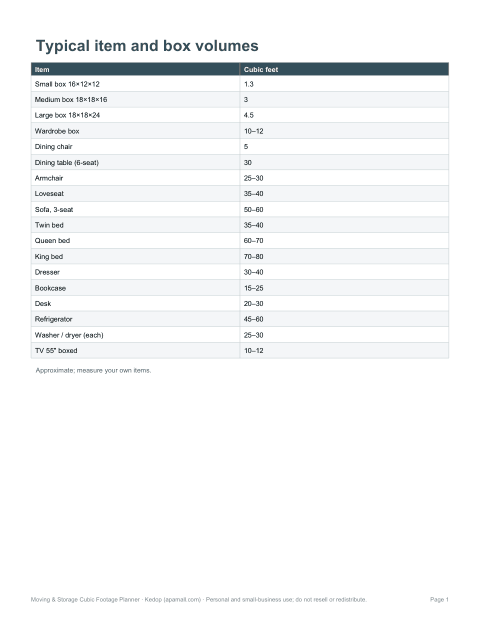
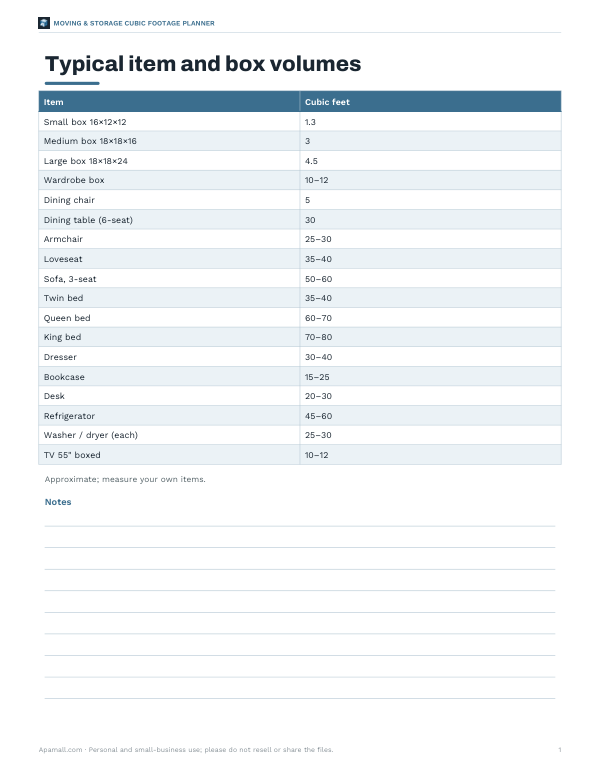
- Standard item volume chart — typical cubic footage for common furniture and appliances, from a dining chair to a king bed.
- Box size chart — common moving box sizes and their volumes, with what to pack in each.
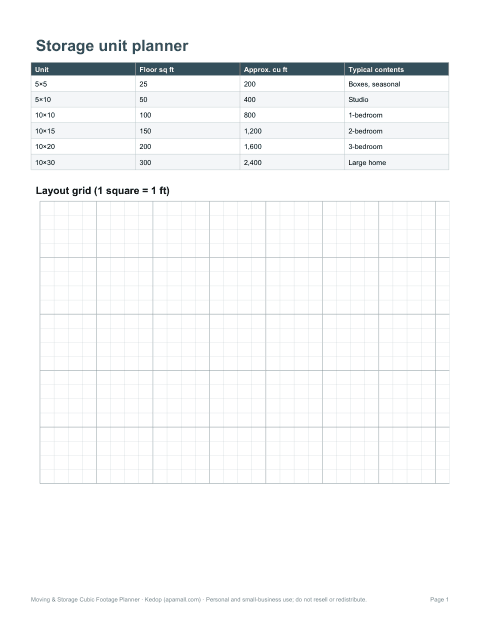
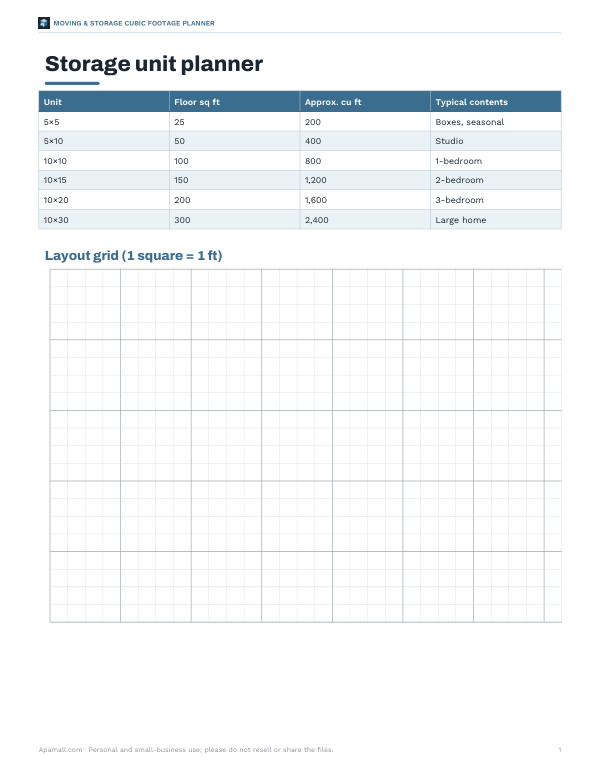
- Storage unit planner — unit sizes with approximate capacity and a floor-plan grid to sketch your layout.
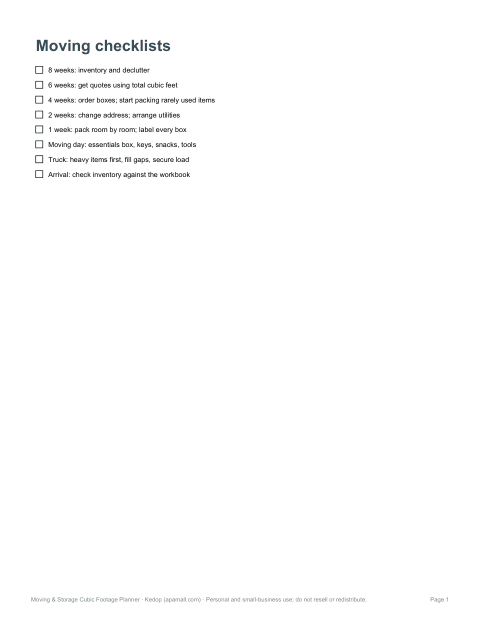
- Room-by-room packing checklist and moving day checklist.
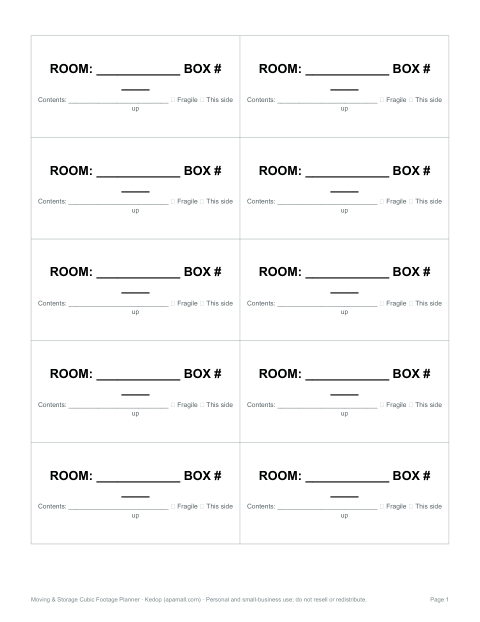
- Box labels — printable labels with room, contents and box number.
Formulas
- Rectangular items and boxes: cubic feet = length × width × height (in feet).
- From inches: cubic inches ÷ 1,728 = cubic feet.
- Cylinders: π × (diameter ÷ 2)² × height.
- Cubic feet × 0.0283 = cubic metres; cubic feet ÷ 27 = cubic yards.
For irregular furniture such as sofas and armchairs, measure the overall length, depth and height — the space they take in a truck — rather than trying to measure the shape exactly.
Typical volumes
| Item | Approx. cubic feet |
|---|---|
| Small moving box (16×12×12 in) | 1.3 |
| Medium moving box (18×18×16 in) | 3.0 |
| Large moving box (18×18×24 in) | 4.5 |
| Dining chair | 5 |
| Armchair | 25–30 |
| Three-seat sofa | 50–60 |
| Queen bed with frame | 60–70 |
| Refrigerator (large) | 45–60 |
| Washer or dryer | 25–30 |
| Dresser | 30–40 |
A common rule of thumb for a whole move is several hundred cubic feet per furnished room, but households vary enormously; the inventory is more reliable than a rule of thumb.
Worked example
Ten medium moving boxes of 18 × 18 × 16 inches are 5,184 cubic inches each, or 3.0 cubic feet — 30 cubic feet in total, about 0.85 cubic metres. Add a queen bed (65 cu ft), a three-seat sofa (55), a dresser (35), four dining chairs (20) and twenty more boxes (60), and the total is about 265 cubic feet — comfortably inside a 10–12 foot truck, or a 10 × 10 ft storage unit stacked efficiently.
Storage unit sizes
| Unit | Floor area | Approx. capacity (8 ft high) | Typically holds |
|---|---|---|---|
| 5 × 5 ft | 25 sq ft | ≈ 200 cu ft | Boxes, seasonal items |
| 5 × 10 ft | 50 sq ft | ≈ 400 cu ft | Studio apartment contents |
| 10 × 10 ft | 100 sq ft | ≈ 800 cu ft | One-bedroom apartment |
| 10 × 15 ft | 150 sq ft | ≈ 1,200 cu ft | Two-bedroom apartment |
| 10 × 20 ft | 200 sq ft | ≈ 1,600 cu ft | Three-bedroom home |
Real usable space is less than the raw volume because furniture does not stack perfectly and you need an aisle. The calculator's storage suggestion allows for this.
Formats
The workbook is an editable XLSX with formulas; charts and checklists are PDF and DOCX; labels print on US Letter paper. Everything works with Excel, Google Sheets, LibreOffice and any PDF reader.
Packing tips that save space
- Use uniform box sizes where possible — they stack much more efficiently.
- Fill boxes completely; half-empty boxes crush and waste space.
- Disassemble beds, tables and shelving and bag the hardware.
- Put heavy items in small boxes and light items in large boxes.
- Stand mattresses and sofas on end in the truck to save floor space.
- Fill appliance interiors and drawers with soft items where allowed.
Frequently asked questions
How do I calculate cubic feet?
Multiply length × width × height in feet, or multiply in inches and divide by 1,728.
How many cubic feet is a 10×10 storage unit?
About 800 cubic feet at an 8-foot stacking height.
What size truck do I need for a two-bedroom apartment?
Often a 15–20 ft truck, but an inventory of your items gives a better answer.
How many cubic feet in a cubic yard?
27 cubic feet.
Is the kit editable?
Yes, the Excel workbook and Word checklists are fully editable.
Was AI used to create the kit?
The templates were drafted with AI assistance and then reviewed, edited and formatted before publishing.